

A More Human Approach to Behavioral Health Architecture

Behavioral health touches far more people than most realize. It isn't confined to a single age group, background, or corner of the healthcare system. It shows up in nearly every community, and increasingly, in nearly every family. According to the Substance Abuse and Mental Health Services Administration's 2024 National Survey on Drug Use and Health, nearly a quarter of U.S. adults, roughly 61.5 million people, experienced a mental illness in the past year, and just over half received any treatment for it.
At its core, behavioral health encompasses mental health and substance use care, with a focus on how people think, feel, behave, and function in their everyday lives. It's a broad, deeply human category of care, and the environments where that care happens carry real weight. As Albert Kahn Associates Healthcare Architect, Hailey LandisFrame, put it, healthcare design is "uniquely situated to provide impact at these key moments in people's lives," precisely because patients often arrive with their emotions already elevated, scared, or unsure. In those moments, thoughtful design can offer comfort and clarity, while poor design can add to the stress.
That reality was a focal point of a recent presentation by Brooke Longcore, Senior Architect at Kahn, delivered to the firm as part of a healthcare think tank series. Gathering research, trends, and best practices already reshaping behavioral health design across the industry, she translated them into a framework overview her colleagues could put into practice every day, weaving together historical context, emerging data, and lessons pulled from the field, all filtered through her own experience designing for people at some of the most vulnerable moments in their lives.
From Institution to Individual
Early portions of Longcore's presentation traced how behavioral health architecture has evolved over the past century, drawing on documented shifts in care models, from the large, self-contained state psychiatric hospitals of the 1920s through the '40s, to today's behavioral health continuum, where care is distributed across outpatient clinics, primary care offices, emergency departments, schools, and community programs.
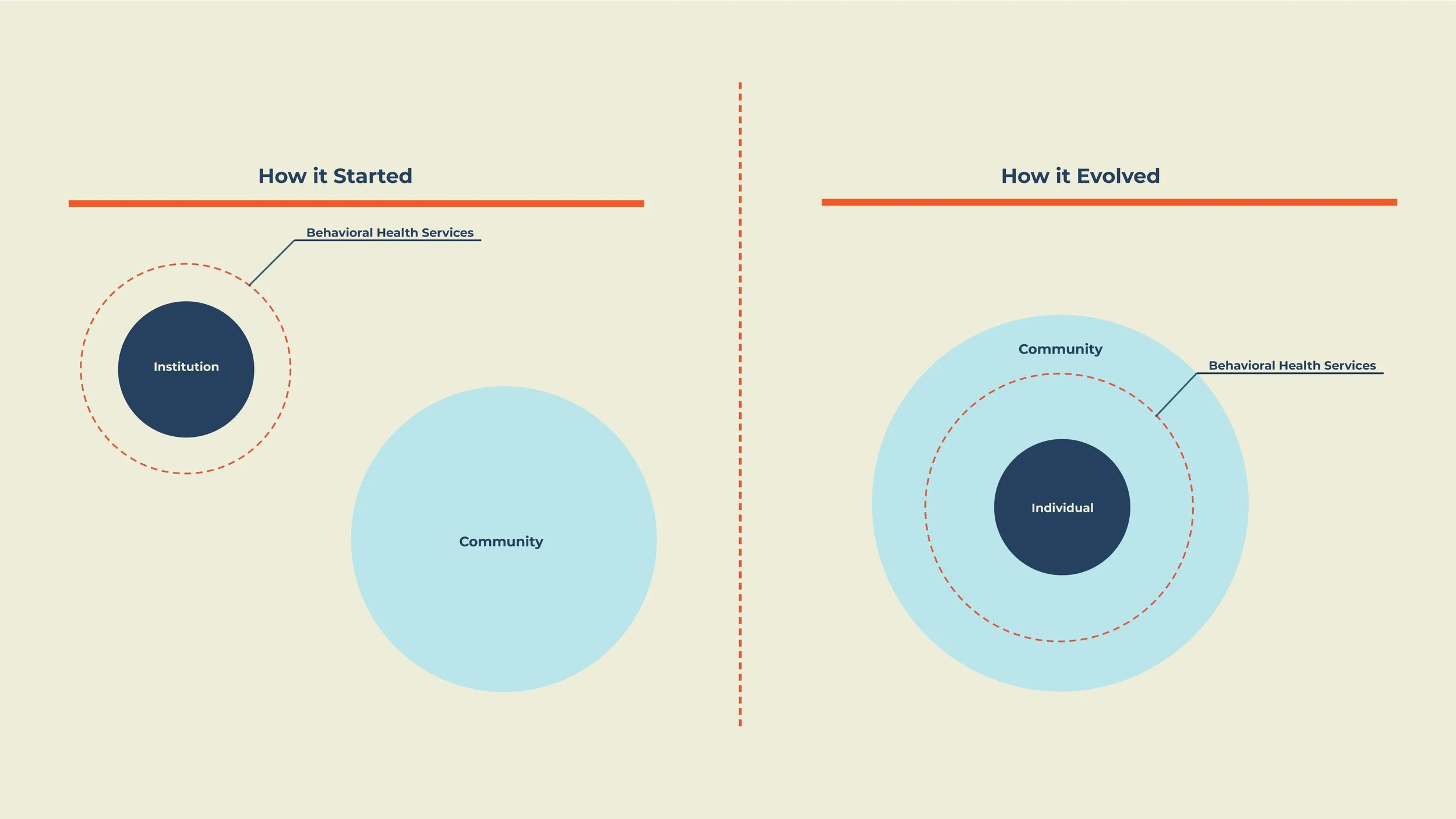
Diagram of relationships between individuals, institutions, and community, via Longcore’s presentation
The shift is as much philosophical as it is architectural. Early behavioral health models treated the "Institution" as a small circle sitting apart from the broader community. Today's model flips that entirely: the Community is the largest circle, Behavioral Health Services live within it, and the Individual sits at the center. Care isn't something people are sent away for anymore. It's something increasingly built into the fabric of daily life.
That shift carries real urgency. Suicide remains the second leading cause of death for ages 10 to 24, and a CDC study of national survey data found that diagnosed rates of mental, emotional, and behavioral conditions rose almost 4% among adolescents ages 12 to 17 between 2016 and 2021, underscoring a growing need to design for all ages, not just adults. While architecture isn't a one-size-fits-all solution to behavioral health and treatment, those design decisions do make a difference in the experiences of patients and their families.
Five Principles Guiding the Field
At the center of Longcore's presentation were five design principles that have emerged as guideposts across behavioral health architecture, each addressing a different dimension of what a person experiences in care:
- Safety: Protecting people without creating a sense of confinement or fear
- Choice + Control: Giving patients opportunities for autonomy, from where they sit to ways of personalizing their own spaces
- Connection: Supporting healing through daylight, nature, and community ties
- Staff Support: Protecting the physical and emotional wellbeing of caregivers
- Dignity + Privacy: Designing for the person, not the diagnosis
That last principle captures something the whole Albert Kahn healthcare team returns to repeatedly. As LandisFrame put it, healthcare design must provide "dignity for everyone... it's really something that is for the broader population, so it can give back to everyone." It's a philosophy that runs through everything Albert Kahn's healthcare designs, from behavioral health facilities to community clinics and major hospitals.
Longcore was careful to frame these five principles as interdependent, not standalone checkboxes. Pursue one without the others, and the result can undercut the very thing the principle was meant to protect:
- Safety without Dignity becomes Institutional
- Choice without Safety becomes Risk
- Privacy without Connection becomes Isolation
- Observation without Control becomes Surveillance
The point, as the think tank discussed it, is that no single principle can carry the weight of good behavioral health design on its own. Safety measures that strip away dignity just rebuild the old asylum model in a new shell. Privacy that isolates a patient from staff and community defeats the purpose of the space. The five principles only work as a system.
Albert Kahn has already put these principles into practice. Corktown Health, Michigan's first clinic dedicated to LGBTQ+ care, offers several behavioral health services alongside primary care, designed with the understanding that LGBT patients often face discrimination, including from providers, and need a setting built on safety and affirmation first. It's the same instinct driving behavioral health design across the field: dignity built into the sequence of a space, not added on afterward.
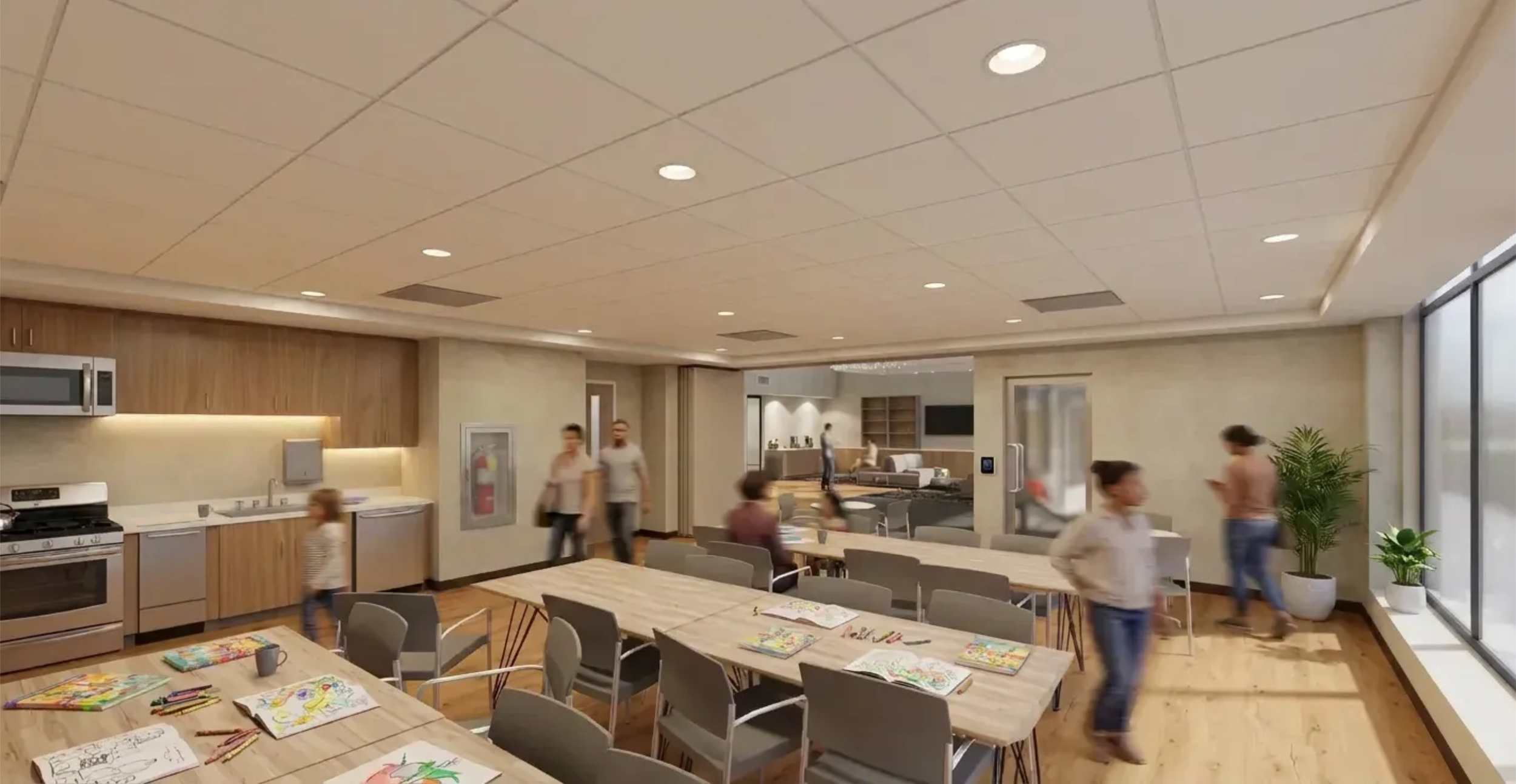
Rendering of Corktown Health
Learning From the Field
Some of the most memorable moments in the discussion came from real examples the team has encountered in their own careers. Kahn Senior Architectural Planner Angie Botorowicz recently visited a restaurant in Traverse City built a psychiatric facility now repurposed as a mixed-use development. Botorowicz noted that each dining booth now occupies roughly the footprint of what was once a single patient's room. Walking through the space, Botorowicz found herself considering how those spaces used to operate, and how differently they might be designed today with patients truly in mind.
It's the kind of observation that speaks to how the whole team approaches this work: looking at buildings, old and new, and asking how design choices, macro to micro, shape the experience of the people inside them.
Inspiration Beyond Healthcare
What stands out in Longcore's presentation is how grounded it is in practical, everyday questions. How would a family feel walking into this facility with their child? Does a young patient need a highly clinical environment, or would a space designed more like a school put them at ease? Could a psychiatric facility be reimagined by studying how other markets, like mixed-use or education, create a sense of comfort and belonging?
These aren't abstract design exercises. They're the kinds of questions the healthcare team is asking on real projects, informed by research and ideas gathered from across the field, as well as Kahn's own work in other industries.
A Story That Says It All
Botorowicz has her own story that captures why this work matters so much. At one industry presentation to a room of 300 to 500 people, the speaker asked how many attendees knew a family member affected by a behavioral health issue. Nearly every hand in the room went up. Only 3 to 5 percent stayed down.
It's a small moment, but it says everything about why this work can't be treated as a niche specialty. Behavioral health isn't something that happens to other people, somewhere else. It's woven through nearly every family, which means the spaces designed to support it deserve every bit of thought, care, and dignity the industry can bring.
Why This Work Matters
Behavioral health design sits at a uniquely emotional intersection of architecture and human experience. As Botorowicz has said, healthcare is "the core of every community," and the buildings a community trusts to care for its most vulnerable moments send a message about how much that community is valued.
For Brooke Longcore and the healthcare design team at Albert Kahn Associates, staying immersed in the latest thinking on behavioral health design isn't optional; it's how they ensure every project reflects the best ideas the field has to offer. While the think tank only scratched the surface of behavioral health architecture, the message remains the same: everyone deserves a space that treats them with safety, choice, connection, and dignity, no matter what they're walking through.
Albert Kahn Associates' healthcare design team specializes in creating environments that support healing for patients, families, and staff alike. Learn more about our behavioral health and healthcare design expertise or contact here.